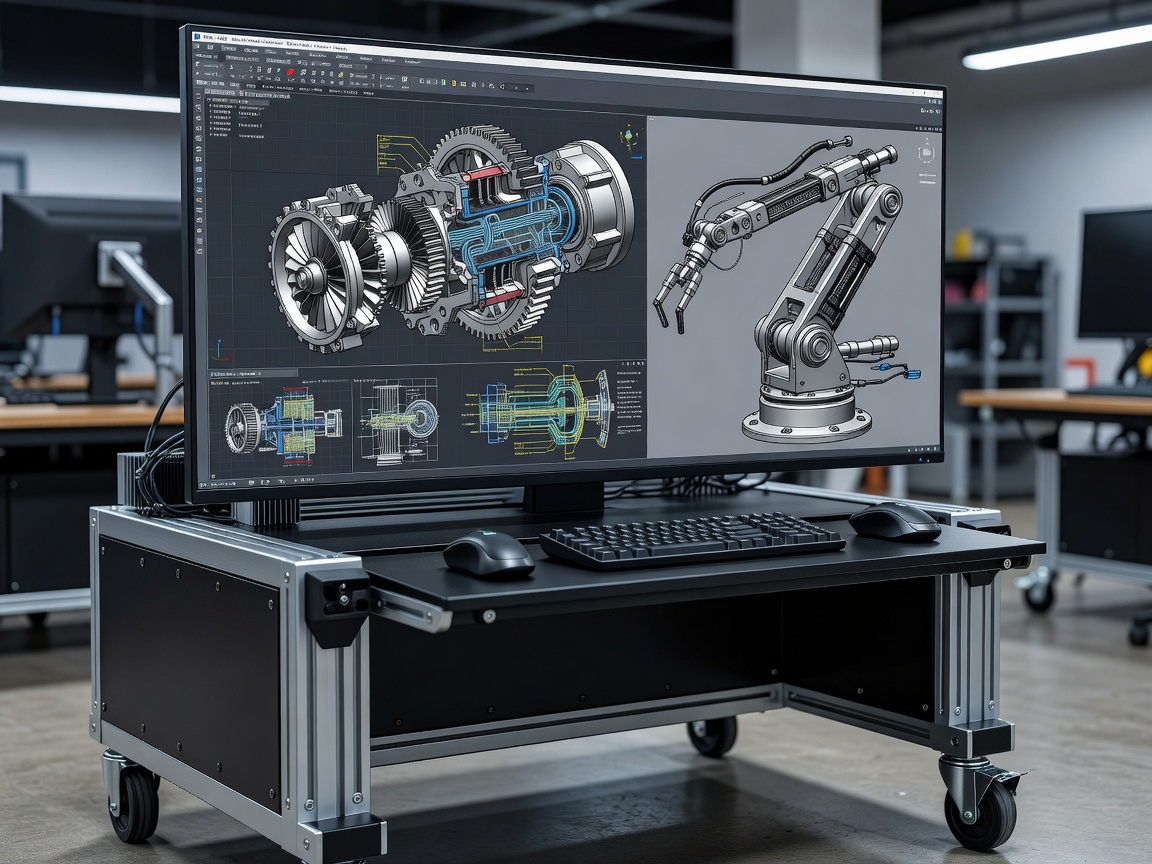
While gaming laptops and ultrabooks cater to consumers, mobile workstations belong strictly to the realm of enterprise professionals. These are unyielding, highly specialized machines designed for engineers, data scientists, architects, and high-end video production professionals. When a single system crash could cost thousands of dollars in lost rendering time, a mobile workstation is the tool you deploy to ensure absolute stability and precision.
ISV Certification: The Gold Standard
The most defining characteristic of a true mobile workstation is Independent Software Vendor (ISV) certification. This is not merely a marketing term; it is a rigorous testing process. Hardware manufacturers collaborate directly with software companies—such as Autodesk, Adobe, Dassault Systèmes, and Siemens—to guarantee that specific laptop configurations will run their software flawlessly.
If you are running AutoCAD or SolidWorks, an ISV-certified machine guarantees that the hardware drivers are tuned for stability rather than raw framerates. If a bug occurs, ISV certification ensures that enterprise support channels will assist you, rather than pointing the blame at uncertified consumer hardware.
Professional GPUs vs. Gaming GPUs
At first glance, the specifications of a mobile workstation might look similar to a high-end gaming laptop. However, the graphical silicon inside serves a vastly different purpose. Workstations typically utilize professional-grade GPUs, such as NVIDIA's RTX Ada Generation (formerly Quadro) series.
Gaming GPUs (like the GeForce RTX line) are optimized for rendering millions of textured polygons as fast as possible, heavily utilizing approximations to keep framerates high. Professional GPUs are optimized for absolute mathematical precision. In a CAD environment, calculating a structural load or a fluid dynamic simulation requires pixel-perfect accuracy; an approximation could lead to catastrophic real-world engineering failures. Professional GPUs also feature specialized drivers optimized for viewport rendering in 3D modeling software, drastically outperforming equivalent gaming GPUs in those specific tasks.
ECC Memory and CPU Muscle
Data integrity is paramount in workstation environments. To combat data corruption, high-end mobile workstations often support Error-Correcting Code (ECC) RAM. ECC memory can detect and correct single-bit memory errors on the fly. While a flipped bit in a video game might result in a temporary graphical glitch, a flipped bit during a multi-day scientific simulation could invalidate the entire dataset. ECC RAM ensures that data written to memory is precisely the data read back.
On the processor front, these machines feature the highest-tier CPUs available, including Intel Core i9 or Xeon processors, and AMD Ryzen Threadripper PRO variants. These chips offer massive core counts, essential for parallel processing tasks like CPU-based rendering, compiling millions of lines of code, or managing complex virtual machines.
Build, Thermals, and Connectivity
Because these laptops are expected to run at maximum load for hours—sometimes days—at a time, their thermal solutions are massive. You will rarely find an ultra-thin true workstation. They feature thick, robust chassis designs built from aerospace-grade aluminum or carbon fiber to withstand the rigors of fieldwork and frequent travel.
Connectivity is another area where workstations excel. They frequently feature a vast array of ports, including multiple Thunderbolt 4 connections, full-sized HDMI or DisplayPort, RJ45 Ethernet for secure network access, and Smart Card readers for enterprise-level security authentication.
Conclusion
Mobile workstations represent a significant financial investment, often costing double or triple the price of a standard laptop. However, for professionals whose livelihoods depend on software stability, mathematical precision, and rapid render times, the return on investment is immediate. They are the heavy machinery of the computing world, built specifically to tackle tasks that would bring consumer hardware to a grinding halt.